Time flies. And sometimes the most exciting things happens as you least expect it. After a long summer in Copenhagen looking for jobs I now find myself in Nairobi, Kenya.
I found a post on Facebook from an acquaintance, e-mailed the guy - had two Skype interviews - and 3 weeks later I was on the plane to Nairobi.
I've gotten a 3 month paid internship for an entrepreneur incubator. My role is to work with business development, by helping 8 tech starts ups improve their business model. Sort of.
What I'm actually doing is working closely with ManyattaRent, which is a Kenya tech-start up that enables tenants to pay rent to their landlords using M-Pesa, the famous mobile money payment system spearheaded here in Kenya.
It's so far going very well and I love what I'm doing. Last week I meet with the COO of Barclays Kenya, and this week I'm meeting with 3 other major banks to convince them that they should partner with us to provide this service to Kenyan tenants. All in all its extremely exciting stuff.
I'll try to write an update or two on this blog every now and then. And perhaps even upload some pictures. But for now you'll have to settle with this short post. Talk soon!
Wednesday, October 17, 2012


Tuesday, April 19, 2011
More on the India Jewel Scam
So, I did a bit of quick research on the web and found this description of the jewel smuggling episode we experienced.
Diamonds (Jaipur) : a very dangerous and professionally organized scam that have mostly happened in Jaipur, but now also have spread to Pushkar, Agra, Goa and
other touristy places. The basic idea is that diamond traders have to pay 250
percent tax when they export to the west. Anybody with a tourist visa can according
to the scam without problems buy and send diamonds to the west as gifts and
then avoid the tax. Around this story a whole theater play gets set up and
performed and the poor tourist gets one of the main roles...
Normally it goes
like this, you meet a very friendly guy and he invites you to a meal in a restaurant.
You meet up again and everything is going very well. After a week or so he
invites you to a family feast (wedding etc) where you enjoy yourselves together
for a few days, everything free of cost for you. The moment that they know
that they have your full trust the next phase starts. Your new friend tells
you that his family has a jewel business and all you have to do is to send
a packet of diamonds to your home in Europe, fly over there and give the packet
to the contact person in your home country and then fly back to India. Everything
paid for of course. The whole thing is done in a couple of days and as a thank
you you will get 10.000 dollar!
After having agreed to help your new friend
you pack the parcel together, bring it to the post and send off the diamonds
to your home address. Then comes the big surprise; since you now have a packet
filled with diamonds worth lots and lots of money soon arriving at your home
they need some kind of assurance that you don't just run off with the treasure
and never return. All you have to do is to sign a paper that gives them the
allowance to enter your bank account and get out at least 10000 euro the moment
that you try to escape. If you refuse to this the problems begin; verbal attempts
to convince you soon turn into threats and torture which might mean you getting
locked up without food or sleep until you finally, weakend by fright and exhaustion,
agree to sign. One Belgian guy was even forced to call to his bank to rise
the limit of his VISA card. Once you have signed they let you go and quickly
disappear, as well as the money on your account. The diamonds arriving to your
home turns out to be polished glass.
This scam seem to be very active, I was
approached by two different diamond dealers in Pushkar who tried this story and a young very friendly guy that first invited me and my friend to a cafe and then the following day wanted to take us to a very expensive restaurant. When we found it a bit too much and felt a bit suspicious he invited us to a coffee again and noticing our un comfort quickly told us the diamond story and the offer of the 10000 dollar. When we after a bit of doubting said no it was not a problem but it also meant the end of the friendship with the young friendly guy. Suddenly we were not interesting anymore and he stopped talking to us, when we left the cafe he did not say goodbye. I heard about many other travelers that had similar experiences, all with more or less the same basic scam story. One variety can be that they want to send carpets.
The scam is still active, and you should also take care in Manali:
From this site:
http://www.hansrossel.com/travel-information/india/scams-travel-safety.htm
other touristy places. The basic idea is that diamond traders have to pay 250
percent tax when they export to the west. Anybody with a tourist visa can according
to the scam without problems buy and send diamonds to the west as gifts and
then avoid the tax. Around this story a whole theater play gets set up and
performed and the poor tourist gets one of the main roles...
Normally it goes
like this, you meet a very friendly guy and he invites you to a meal in a restaurant.
You meet up again and everything is going very well. After a week or so he
invites you to a family feast (wedding etc) where you enjoy yourselves together
for a few days, everything free of cost for you. The moment that they know
that they have your full trust the next phase starts. Your new friend tells
you that his family has a jewel business and all you have to do is to send
a packet of diamonds to your home in Europe, fly over there and give the packet
to the contact person in your home country and then fly back to India. Everything
paid for of course. The whole thing is done in a couple of days and as a thank
you you will get 10.000 dollar!
After having agreed to help your new friend
you pack the parcel together, bring it to the post and send off the diamonds
to your home address. Then comes the big surprise; since you now have a packet
filled with diamonds worth lots and lots of money soon arriving at your home
they need some kind of assurance that you don't just run off with the treasure
and never return. All you have to do is to sign a paper that gives them the
allowance to enter your bank account and get out at least 10000 euro the moment
that you try to escape. If you refuse to this the problems begin; verbal attempts
to convince you soon turn into threats and torture which might mean you getting
locked up without food or sleep until you finally, weakend by fright and exhaustion,
agree to sign. One Belgian guy was even forced to call to his bank to rise
the limit of his VISA card. Once you have signed they let you go and quickly
disappear, as well as the money on your account. The diamonds arriving to your
home turns out to be polished glass.
This scam seem to be very active, I was
approached by two different diamond dealers in Pushkar who tried this story and a young very friendly guy that first invited me and my friend to a cafe and then the following day wanted to take us to a very expensive restaurant. When we found it a bit too much and felt a bit suspicious he invited us to a coffee again and noticing our un comfort quickly told us the diamond story and the offer of the 10000 dollar. When we after a bit of doubting said no it was not a problem but it also meant the end of the friendship with the young friendly guy. Suddenly we were not interesting anymore and he stopped talking to us, when we left the cafe he did not say goodbye. I heard about many other travelers that had similar experiences, all with more or less the same basic scam story. One variety can be that they want to send carpets.
The scam is still active, and you should also take care in Manali:
"I just came home from India where I got mixed up in the jewel scam
you mention on your web site (I feel like a real sucker).
Anyway, I just wanted to inform
you that I was approached in Manali and then taken to Jaipur. So you might
wanna add Manali as another place the scam takes place.
They were also very interested in my guide book, which suddenly and silently
dissapeared while on the way to Jaipur. They obviously did not want me to read
about the scam.
I can, if you are interested, give you the name of the company.
But I suppose this was just a front for the operation, and that they change
this name all the time."
James, 6 june 2007
Tuesday, April 12, 2011
In the land of Cricket, Curry, Tigers and the Taj!
(Note: This post was writing two days ago, but was first able to upload it now)
It’s 3am. We’re doing 140 on a dark highway in the middle of Uttar Pradesh in a brand new white Tata Indigo XL. Our driver, Bilal, is seems very competent and have not fallen asleep yet, despite the task we set him up to. But before we go on, lets backtrack a bit.
I arrived in India late Sunday night on the 3rd of April. I had just spent an astonishing week in Dubai, a city that aside from the lack of gambling and prostitutes brings Las Vegas to shame. The best way I can explain Dubai is by comparing it to the old computer game SimCity, but with cheat codes giving unlimited money. The point of the game is to build a city and run it. You can alter everything in the geography, such as waterways, hills, islands, etc. to suit your urban needs. And Dubai is just that. A city built from scratch on a clean slate with almost unlimited supplies of money. If you want to see what Oil can do other than fuel your car, heat your house, cause wars in the middle east and environmental havoc in the Amazonian rainforest, then Dubai would not be a bad place to experience it.
Later that night I met up with Jeppe, one of my oldest and best friends from my childhood who was going to join my for a 2 week India adventure. We spent the first day in Delhi getting used to the city, the people, the food and the general atmosphere every place and country has. The feel you get from walking down the narrow alleys, the smiles or lack thereof you get from talking to people and other indications that give you an idea of what kind of culture you are finding yourself in.
I was warned numerous times ahead of my journey that I would find India dirty, smelling, crowded, and chaotic and should to expect lots of problems with my digestive system due to the low level of hygiene. So is this the case?
Well, it depends. Everything is relative and if you compare India to our comfortable western world - then yes, it is dirty here. It smells. It is at times extremely crowded and seemingly chaotic. The hygiene is not always, if at all, up to western standards. But compared to Western Africa or Central America I see little difference and in many ways find India a lot easier to travel in. I would in fact say it’s on of the easiest countries I’ve travelled in so far. An observation that both Jeppe and I have discussed several times and agrees on. There is a big industry catering to tourists, a growing middleclass, and a very good infrastructure that makes transport relatively simple. The major thing I’m surprised about is the low level of English or complete lack of English skills many people have. I was under the impression that everyone at least spoke some English. Apparently not. But we are still doing well and have managed to get by with smiles and sign language, when our spoken words did not suffice.
Fast forward 24hours. After spending the day sightseeing various forts and palaces, a tuk-tuk (a little 3-wheled moped-taxi) driver, who’s cousin was getting married the day before, asked if we wanted to attend a party with his boss (he claimed to also work at a jewelry store). Out of curiosity of what an Indian party might consist of Jeppe and I accepted his offer and drove with him to a 5 star hotel where the “party” would take place. There turned out to be no party. Instead Jeppe and I were drinking beer with a person who owned a jewelry exporting/importing business and gave us an offer that we could (almost) not refuse. After spending about 30 minutes asking us question about our lives and what we were doing in India and how we liked it, he said that perhaps we could help him with his business.
According to him, the Indian government has limit for how much jewelry a business like his could export without facing export duties. In order to avoid these duties, he wanted to send some jewelry to Denmark in our name, since tourist (he claimed) could bring with them 15.000 USD worth of jewelry every time the left the country. So, in order to tap into these 15.000 USD duty-free tourist limit he told us that we could come to his business and “buy” jewelry for 15.000 USD. We wouldn’t in actuality buy anything at all, but he would issue a receipt so it looked like we had purchased a lot of jewelry. He then said he would let us watch as he wrapped the goods into a package and bring us to the postal office where he, in our name, with our passports, would send the jewelry back home to our own address in Denmark. In this way the jewelry would go through customs as a tourist purchase and not as actual business export. We would then pick up the same package back at our post office in Denmark and give it to one of his agents in Denmark in return for (what he claimed to be) 8.000 Euro (60.000kr) in cash. It almost sounds like too easy money to be true.
Neither Jeppe nor I have had time to research the Indian tax-code and export duties for Jewelry, but if you as a tourist are really allowed to purchase (and bring with you home) 15.000 USD worth of jewelry in India, and are likewise permitted to import a similar amount into the EU without facing import duties the plan sounded quite ingenious. And a major loophole in the tax-code system that this guy was eagerly trying to exploit. To be honest; even though both Jeppe and are I in sound financial standing, the though of so much money for doing so little, with a method that seemed almost foolproof (since we would have a receipt verifying the purchase) – actually made us considered the option for about 10 seconds. We of course both declined and said we would make no rushed decisions and 5 minutes later in the cab back to our hotel we could of course both see that this was never something we would get ourselves into. I am however still intrigued to see if this would actually work – not for the money, but too see if it is really possible to smuggle (which this clearly is) jewels this way. If so, it would be a major loophole in the tax-code and would be really interesting for a documentary. Most gemstones that go into jewelry are not, as diamonds are, registered under the Kimberly Process. This process ensures that diamonds are not smuggled from conflict areas where they could potentially fuel violence and war (as portrayed in the movie Blood Diamonds). There is no way to know where the gemstones used in the jewelry he tried to make us smuggle came from. They could very well come from India, but also from a vast range of other countries, peaceful as well as war-torn. Think about that next time you go by Tiffany’s and purchase a necklace or an earring with Ruby or Emerald. Perhaps the jewelry was smuggled with a tourist from India, and in that way depriving the Indian government from money it desperately needs to help improve the living standard for it’s people.
After our Jaipur experiences we took off to Ranthambhore (http://www.ranthamborenationalpark.com), a stunning national park known for it’s massive fort on the top of a mountain and it’s great wildlife. Tigers used to be the big thing here, but like many other wildlife parks in the world – their numbers have decreased as a result of poaching and loss of habitat.
After arriving by train we lodged into a nice hotel and booked a sunrise tour with a Jeep. The park itself (even without the tigers) is stunning and the roads often look like the ones used in Indiana Jones movies. With monuments, ruins, narrow bridges, steep hills and stunning nature everywhere. Our guide told us that there were presently only 46 tigers left in the part, so the chances of seeing one was limited. Luck was not on our side that morning, so no tiger decided to greet us in the park. We however saw loads of peacocks, dears, monkeys, birds and two leopards – making it an overall successful safari.
Later that day we jumped on a train towards Agra, the home of Taj Mahal. We were unable to purchase tickets with actual designated seats on them – which caused a bit of a problem. First we sat on the floor between two compartments in the AC wagon, but got kicked out since our ticket was only valid in the 3rd class section (despite our location on the floor). So once the train stopped, we took all our luggage and ran down the train and jumped into a 3rd class wagon. This wagon was completely packed with people. We ended up sitting/standing in the middle of a compartment for around 2 hours while everyone was watching curiously and wondering how two white people had ended up there. In the end we did however make it to Taj Mahal.
It’s 3am. We’re doing 140 on a dark highway in the middle of Uttar Pradesh in a brand new white Tata Indigo XL. Our driver, Bilal, is seems very competent and have not fallen asleep yet, despite the task we set him up to. But before we go on, lets backtrack a bit.
I arrived in India late Sunday night on the 3rd of April. I had just spent an astonishing week in Dubai, a city that aside from the lack of gambling and prostitutes brings Las Vegas to shame. The best way I can explain Dubai is by comparing it to the old computer game SimCity, but with cheat codes giving unlimited money. The point of the game is to build a city and run it. You can alter everything in the geography, such as waterways, hills, islands, etc. to suit your urban needs. And Dubai is just that. A city built from scratch on a clean slate with almost unlimited supplies of money. If you want to see what Oil can do other than fuel your car, heat your house, cause wars in the middle east and environmental havoc in the Amazonian rainforest, then Dubai would not be a bad place to experience it.
This post is however not on Dubai, if I have time and energy – a post on Dubai will follow in somewhat irregular chronological order.This post is about my experiences so far in the land of cricket, curry, tigers and Taj Mahal.
After arriving in the airport and for the first time setting my foot on the Asian continent, I took a cab to the hotel I had booked in advance. Despite the late hour the streets of Delhi were filled with cars and judging by the speed and reckless driving it seemed like the driver thought of this trip as a matter of life and death. However not inconsistent with my experiences with drivers in both Africa and Central America.
After arriving in the airport and for the first time setting my foot on the Asian continent, I took a cab to the hotel I had booked in advance. Despite the late hour the streets of Delhi were filled with cars and judging by the speed and reckless driving it seemed like the driver thought of this trip as a matter of life and death. However not inconsistent with my experiences with drivers in both Africa and Central America.
Later that night I met up with Jeppe, one of my oldest and best friends from my childhood who was going to join my for a 2 week India adventure. We spent the first day in Delhi getting used to the city, the people, the food and the general atmosphere every place and country has. The feel you get from walking down the narrow alleys, the smiles or lack thereof you get from talking to people and other indications that give you an idea of what kind of culture you are finding yourself in.
I was warned numerous times ahead of my journey that I would find India dirty, smelling, crowded, and chaotic and should to expect lots of problems with my digestive system due to the low level of hygiene. So is this the case?
Well, it depends. Everything is relative and if you compare India to our comfortable western world - then yes, it is dirty here. It smells. It is at times extremely crowded and seemingly chaotic. The hygiene is not always, if at all, up to western standards. But compared to Western Africa or Central America I see little difference and in many ways find India a lot easier to travel in. I would in fact say it’s on of the easiest countries I’ve travelled in so far. An observation that both Jeppe and I have discussed several times and agrees on. There is a big industry catering to tourists, a growing middleclass, and a very good infrastructure that makes transport relatively simple. The major thing I’m surprised about is the low level of English or complete lack of English skills many people have. I was under the impression that everyone at least spoke some English. Apparently not. But we are still doing well and have managed to get by with smiles and sign language, when our spoken words did not suffice.
So, after a day in Delhi where also met my good friend Tess’s lovely and friendly aunt Lena, we caught a bus to the city of Jaipur. Known for temples, history, jewels and textiles. We spent 3 nights in the city.
I will not recite every fort we visited or every meal we had. But two experiences stand out to be shared. I went to an Indian wedding and I was asked to smuggle jewels.
On the Wednesday we stumbled into an American student who was taking a semester abroad in Delhi. We talked a bit and it turned out that he was going to a wedding the same evening. He organized so that Jeppe and I, together with 3 American girls we had met earlier the day, could come along.
The wedding took place outside in a big open court. At our arrival neither the groom nor the bride had arrived, but the area was crowded with people – and at the time we seemed to be the main attraction. 30 people standing in a circle around us observed our every move closely. Unlike other experiences I’ve had in Africa these weren’t only kids but young and middle-aged men. They simply just stood and starred and tried to get as close to us as possible. This fascination with “Whites” has occurred several times. Often people have come up and asked if they could take a picture with us. We don’t really know why. The places we’ve been so far have been fairly big on tourism so the sight of a white person is not exactly an unusual exotic occurrence.
After eating delicious food and watching the groom arrive with a tuba-playing band dressed in pink we decided to call it a day and go home and sleep.
I will not recite every fort we visited or every meal we had. But two experiences stand out to be shared. I went to an Indian wedding and I was asked to smuggle jewels.
On the Wednesday we stumbled into an American student who was taking a semester abroad in Delhi. We talked a bit and it turned out that he was going to a wedding the same evening. He organized so that Jeppe and I, together with 3 American girls we had met earlier the day, could come along.
The wedding took place outside in a big open court. At our arrival neither the groom nor the bride had arrived, but the area was crowded with people – and at the time we seemed to be the main attraction. 30 people standing in a circle around us observed our every move closely. Unlike other experiences I’ve had in Africa these weren’t only kids but young and middle-aged men. They simply just stood and starred and tried to get as close to us as possible. This fascination with “Whites” has occurred several times. Often people have come up and asked if they could take a picture with us. We don’t really know why. The places we’ve been so far have been fairly big on tourism so the sight of a white person is not exactly an unusual exotic occurrence.
After eating delicious food and watching the groom arrive with a tuba-playing band dressed in pink we decided to call it a day and go home and sleep.
Fast forward 24hours. After spending the day sightseeing various forts and palaces, a tuk-tuk (a little 3-wheled moped-taxi) driver, who’s cousin was getting married the day before, asked if we wanted to attend a party with his boss (he claimed to also work at a jewelry store). Out of curiosity of what an Indian party might consist of Jeppe and I accepted his offer and drove with him to a 5 star hotel where the “party” would take place. There turned out to be no party. Instead Jeppe and I were drinking beer with a person who owned a jewelry exporting/importing business and gave us an offer that we could (almost) not refuse. After spending about 30 minutes asking us question about our lives and what we were doing in India and how we liked it, he said that perhaps we could help him with his business.
According to him, the Indian government has limit for how much jewelry a business like his could export without facing export duties. In order to avoid these duties, he wanted to send some jewelry to Denmark in our name, since tourist (he claimed) could bring with them 15.000 USD worth of jewelry every time the left the country. So, in order to tap into these 15.000 USD duty-free tourist limit he told us that we could come to his business and “buy” jewelry for 15.000 USD. We wouldn’t in actuality buy anything at all, but he would issue a receipt so it looked like we had purchased a lot of jewelry. He then said he would let us watch as he wrapped the goods into a package and bring us to the postal office where he, in our name, with our passports, would send the jewelry back home to our own address in Denmark. In this way the jewelry would go through customs as a tourist purchase and not as actual business export. We would then pick up the same package back at our post office in Denmark and give it to one of his agents in Denmark in return for (what he claimed to be) 8.000 Euro (60.000kr) in cash. It almost sounds like too easy money to be true.
Neither Jeppe nor I have had time to research the Indian tax-code and export duties for Jewelry, but if you as a tourist are really allowed to purchase (and bring with you home) 15.000 USD worth of jewelry in India, and are likewise permitted to import a similar amount into the EU without facing import duties the plan sounded quite ingenious. And a major loophole in the tax-code system that this guy was eagerly trying to exploit. To be honest; even though both Jeppe and are I in sound financial standing, the though of so much money for doing so little, with a method that seemed almost foolproof (since we would have a receipt verifying the purchase) – actually made us considered the option for about 10 seconds. We of course both declined and said we would make no rushed decisions and 5 minutes later in the cab back to our hotel we could of course both see that this was never something we would get ourselves into. I am however still intrigued to see if this would actually work – not for the money, but too see if it is really possible to smuggle (which this clearly is) jewels this way. If so, it would be a major loophole in the tax-code and would be really interesting for a documentary. Most gemstones that go into jewelry are not, as diamonds are, registered under the Kimberly Process. This process ensures that diamonds are not smuggled from conflict areas where they could potentially fuel violence and war (as portrayed in the movie Blood Diamonds). There is no way to know where the gemstones used in the jewelry he tried to make us smuggle came from. They could very well come from India, but also from a vast range of other countries, peaceful as well as war-torn. Think about that next time you go by Tiffany’s and purchase a necklace or an earring with Ruby or Emerald. Perhaps the jewelry was smuggled with a tourist from India, and in that way depriving the Indian government from money it desperately needs to help improve the living standard for it’s people.
After our Jaipur experiences we took off to Ranthambhore (http://www.ranthamborenationalpark.com), a stunning national park known for it’s massive fort on the top of a mountain and it’s great wildlife. Tigers used to be the big thing here, but like many other wildlife parks in the world – their numbers have decreased as a result of poaching and loss of habitat.
After arriving by train we lodged into a nice hotel and booked a sunrise tour with a Jeep. The park itself (even without the tigers) is stunning and the roads often look like the ones used in Indiana Jones movies. With monuments, ruins, narrow bridges, steep hills and stunning nature everywhere. Our guide told us that there were presently only 46 tigers left in the part, so the chances of seeing one was limited. Luck was not on our side that morning, so no tiger decided to greet us in the park. We however saw loads of peacocks, dears, monkeys, birds and two leopards – making it an overall successful safari.
Later that day we jumped on a train towards Agra, the home of Taj Mahal. We were unable to purchase tickets with actual designated seats on them – which caused a bit of a problem. First we sat on the floor between two compartments in the AC wagon, but got kicked out since our ticket was only valid in the 3rd class section (despite our location on the floor). So once the train stopped, we took all our luggage and ran down the train and jumped into a 3rd class wagon. This wagon was completely packed with people. We ended up sitting/standing in the middle of a compartment for around 2 hours while everyone was watching curiously and wondering how two white people had ended up there. In the end we did however make it to Taj Mahal.
Taj Mahal was stunning. No other way to describe it. Despite the many tourists, Taj Mahal is a monument that never fails to impress. We woke up early and entered at sunrise to avoid the majority of the tourist. For one reason or another, no one checked our ticket – so we decided also to enter in the afternoon, at which time it was packed with tourist everywhere.
In the evening we tried to catch an overnight train to Varanasi. Varanasi is located right on the Ganges River and is one of the holiest places in Hinduism. A “must-see” if you are in India we had been told. We had bought the tickets 2 days earlier on the Internet and despite being nr. 3 & 4 on the waiting list at the time of purchase, we had been assured that it would be no problem getting a seat. This turned out not to be true. After a lot of talking, haggling and running up and down the station with a helpful porter, we ended up not managing to get a bed(or a set) on the train. While trying to figure what to do now, a man came up and said he could drive us all the way to Varanasi overnight in his car for 8. 000 rupees (180$). Not having any better ideas we decided to at least go with him and check out his car, and see if was really up for the task. With us came to British guys, who had ended up in the same situation as we had. After talking a bit with him and looking at the car we decided that 2000 Rupees(45$) per person, was well worth the trip given our situation.
In the evening we tried to catch an overnight train to Varanasi. Varanasi is located right on the Ganges River and is one of the holiest places in Hinduism. A “must-see” if you are in India we had been told. We had bought the tickets 2 days earlier on the Internet and despite being nr. 3 & 4 on the waiting list at the time of purchase, we had been assured that it would be no problem getting a seat. This turned out not to be true. After a lot of talking, haggling and running up and down the station with a helpful porter, we ended up not managing to get a bed(or a set) on the train. While trying to figure what to do now, a man came up and said he could drive us all the way to Varanasi overnight in his car for 8. 000 rupees (180$). Not having any better ideas we decided to at least go with him and check out his car, and see if was really up for the task. With us came to British guys, who had ended up in the same situation as we had. After talking a bit with him and looking at the car we decided that 2000 Rupees(45$) per person, was well worth the trip given our situation.
And this is where I’m sitting now. Dawn is slowly breaking and I’m very excited to experience Varanasi, right on the Ganges River – one of the holiest places in Hinduism, where ceremonies goes on all day. People are burnt in public on their way to heaven and where the extremely dirty water of the Ganges is suppose to cleanse ones soul. But first it’s time for a nap . . .Zzzzz..
(Internet here is too slow, so can't upload any photos. Will try to upload some later)
Friday, December 24, 2010

Tuesday, December 21, 2010
Le Voyage of West Africa
This will be short post, since im on limited time with a terrible keyboard at an internet cafe in Bamako, Mali. Left Ghana last tuesday after finishing my last exam on the saturday. The last days were spent packing and saying good bye to all the fantastic people i studied and lived with, many of whom ill probably never see again.
My travelling companion for this trip is Halea from UC Berkeley - whom I met at my time in Ghana and who, like me, have a big passion for travelling. In addition she, like me, had time to travel through west africa over christmas, so we decided to plan our "voyage" together. French is intruding my vocab here. A note my mother: Im getting by everywhere in french. Halea speaks less than me, so Im the french speaker, which doesnt say a lot. but hey - were still alive. !!!
So our voyage so far: We went from Accra to Ouagadougou, and then on to Mopti in Mali. From there we took a boat up the river to Timbuktu. Fantastic 2 day journey, on a public african transport boat. In other words Epic!. After a day in Timbuktu, which included visits to old mosques and a camel trip into the desert, we spent all day yesterday making our way to Bamako in Western Mali. (check google maps).
Tomorrow we are heading to Dakar, before leaving towards Banjul on the 25th, to catch a flight to Sierra Leone. in Sierra Leone we'll spend two weeks doing a mosquito-net-usage survey, as a follow-up to a distribution this past summer(see www.gmin.org).
When I have more time, and energy, ill elaborate more in detail. Upload some pictures, share some funny anecdotes etc. But that will have to wait for now.
Cheers,
Jacob and Halea in West Africa (currently Bamako, Mali)
My travelling companion for this trip is Halea from UC Berkeley - whom I met at my time in Ghana and who, like me, have a big passion for travelling. In addition she, like me, had time to travel through west africa over christmas, so we decided to plan our "voyage" together. French is intruding my vocab here. A note my mother: Im getting by everywhere in french. Halea speaks less than me, so Im the french speaker, which doesnt say a lot. but hey - were still alive. !!!
So our voyage so far: We went from Accra to Ouagadougou, and then on to Mopti in Mali. From there we took a boat up the river to Timbuktu. Fantastic 2 day journey, on a public african transport boat. In other words Epic!. After a day in Timbuktu, which included visits to old mosques and a camel trip into the desert, we spent all day yesterday making our way to Bamako in Western Mali. (check google maps).
Tomorrow we are heading to Dakar, before leaving towards Banjul on the 25th, to catch a flight to Sierra Leone. in Sierra Leone we'll spend two weeks doing a mosquito-net-usage survey, as a follow-up to a distribution this past summer(see www.gmin.org).
When I have more time, and energy, ill elaborate more in detail. Upload some pictures, share some funny anecdotes etc. But that will have to wait for now.
Cheers,
Jacob and Halea in West Africa (currently Bamako, Mali)
Saturday, November 27, 2010
Living the Dream: Motorbiking to Burkina Faso
It’s been a while since I last wrote, so I’ll try to summarize quickly what has happened down here in Ghana, before going on to talk about my amazing adventure to Burkina Faso.
As my last post revealed I purchased a motorbike a few weeks back. An American classmate of mine had bought one earlier on and seeing him drive one got me inspired to get one myself. For the irresistible price of 830USD(4600dkk) I got myself a brand new bike, including two helmets, international insurance, registration and some extra safety gear.

Since my Benin trip I haven’t left the country and in general the last couple of weeks had been very relaxed. In late October of my two friends, Jeppe and Tea, came down a week from Denmark to visit me. Having them around was great and we had a splendid week with Biking, Kayaking, Partying and Ambassador visits. It was also very nice for me to have someone come down and see how I live my life in Ghana. It’s nice to have someone who has a first hand understanding of what you say when you try to explain your daily consumption of plastic water or the completely chaotic streets of Accra.

The following weeks not much took place. The teacher-strike ended just as Jeppe and Tea left and school thus resumed the week after. There was a lot of work to do, since we all had to catch up from all the stuff we missed during the strike. The strike also caused the semester to be moved 3 weeks, so we are having all our exams in 1 week in early December, instead of over 4 weeks time as originally planned.
Then about two weeks ago, Kaisa and I decided to take advantage of the fact that we had no exams and take a 9 day trip to Burkina Faso.

We left early Friday morning dressed in janitor/safety clothes that we had bought the day before. This served not only as protection from bugs, stones and the unfortunate event of a crash, but it also turned out to be a great ticket to get through tricky situations. Every time we came to a police barrier, or any other sort of checkpoint, we were quickly let through with no questions asked. I’m not sure exactly why, but I think people genuinely thought of us as some sort of road construction supervisors, or simply didn’t know what to think and therefore decided to let us through. The bottom-line is that we didn’t have a single problem with the authorities during our trip.

We rode almost 10 hours the first day without any problems, and made it more than halfway through Ghana. The first 60km out of Accra are terrible. In addition I took a wrong turn so we ended up driving through the construction site for the new road instead of taking the detour everyone else takes. Again – all the construction workers (apparently) thought we had some official business there, cause they let us through and pointed us in the right direction without asking any questions.
By nightfall we had driven some 450km to Kintampu in the center of Ghana. We found a small guesthouse and lodged there for the night. At the washroom I stumbled into this gigantic fellow.

I later learned that this little bug is a female (I currently forgot its name) and that it apparently eats the male after reproductive intercourse. How interesting. And how fortunate that the human world doesn’t work like that. . .
The next day we continued on towards Ouagadougou in Burkina Faso. We made a short stop in the City of Tamale in Northern Ghana to change oil and tighten the chain on Mulan ( Since my bike is Chinese we decided to give it a Chinese name, and we figured that “Mulan” - inspired by the Chinese warrior – was a suitable name).

In northern Ghana there are road-side-mechanics everywhere so finding one that could do the job was easy. I ended up paying 7 USD(35kr) for new oil and 2USD(10kr) for the work. Not to shabby.
We made it to the border without problems, and crossing it with Mulan was piece of cake. I had read some blogs and stories on the Internet about problems when it came to brining a vehicle across borders in West Africa. In many places you apparently need loads of papers and permissions to bring your bike or car with you, but apparently not into Burkina Faso. The roads in Burkina Faso were surprisingly good and we made it to Ouagadougou (from now on just referred to as “Ouaga”) by 4.30pm. Two hours earlier than we had estimated.

The difference between Ghana and Burkina is quite striking. First of all, Burkina is Francophone, which means everything takes places in French. Kaisa speaks no French at all, and my French consist of 4 years of elementary school French that I have completely forgotten. I did spend the last few weeks studying a few words, but by no means enough to have long or meaningful conversations. The most useful world I learned was “Le Plein, S’il Vous Plait”, which means something along the lines of “Full, Please” or “Fill it up, Please”. Quite useful to know when buying Gasoline.
Secondly, Burkina is landlocked and extremely hot. At times the temperature would surpass 40 degrees Celsius !!! Fortunately the weather is a lot drier than in Ghana, which means that the heat is not as unbearable, despite the higher temperature.
Ouagadougou as a city was a big surprise to me. My expectations were very low and I was expecting to see a very poor city with few modern buildings and little organization. But Ouaga is quite the contrary. Lots of nice buildings, good roads, organized infrastructure. Most of the streets have “biking lanes” designated for the myriad of mopeds sweeping through the city. As opposed to Accra, Ouaga is a moped-city. Almost everyone got around on mopeds, which eased traffic so much that we in the days we were there never ran into any traffic jams. And it also made us feel very home on Mulan.
In Ouaga we stayed with a nice couple, Pavel and Marjorie, which we had found on Couch surfing (if not familiar with the couch surfing concept see www.couchsurfing.com). Marjorie had taken a job on a 1-year contract to teach French at an international school, and her partner Pavel was working as a web designer from home.

The first day (Sunday) in Ouaga, Kaisa and I went to a Sacred Crocodile Sanctuary. The crocodiles there are considered holy and since chickens are “sacrificed” to them on a regular basis they are fairly tame(can a crocodile be tame?) and well fed.
We sat on some crocodiles and watched while they ate some living chickens. Quite an experience.

Monday morning we left Ouaga early. We drove north all day, through beautiful scenery and landscapes until we by nightfall made it to Goram-Goram in the northeastern part of Burkina Faso. Goram-Goram lies in the Sahel Dessert, not to be confused with the Sahara. The Sahel is a semi-dessert in the sense that, trees and other vegetations is present, but sparsely distributed and they are not expecting any rain until early June.
In Goram-Goram we arranged a 24hour Camel trip out into the wild. After spending the night in a mud hut, we left early next morning with 3 camels, equipment and a Guide. Out guide Yussuna, spoke amazing 7 different languages, including French and (some) English.

We rode for a few hours before taking a mid-day break at a local village in the middle of bum-f**k-nowhere. We put out some mattresses under a tree and had a small lunch and investigated this small kind village.

After spending the midday heat in the sun, we continued on and set up a camp on some sand dunes further out in the desert. Out there we had a gorgeous night under the open sky, and were woken up 5am next morning to see the stunning sunrise, before riding back to Goram-Goram.

When we came back it turned out that our visit coincided with a Muslim Holiday. As a result we were invited to join Yussuna’s brother’s family for lunch celebration. They had slaughtered to big goats and the entire family was busy cooking. What a meal in the middle of the dessert. J - again, it always surprises me to see how hospitable and friendly people are in the most far away places. Here we come, two white people on a motorbike, dressed in blue janitor-suits and suddenly we are invited to join for a Muslim Holiday Celebration with a local family, all dressed up and working hard to make sure we are having a good time. Fantastic.

We returned to Ouaga the same evening, and spend the night at Pavel and Marjorie’s place again. Next morning I got myself a Visa de Pais de L’entente(a 5 country visa), and we visited an arts and craft center, before returning back to Ghana. After a long ride from Ouaga, we made it to Bolgatange some 60km into Ghana.
Next morning, we visited the Tonga Hills and the Shenzu Shrine. All the hills in the particular area are covered with massive rocks and makes for quite spectacular scenery.

We had a nice tour around the village, where a guide told us about the ceremonial and spiritual practices of the local people. The chief has a large authority and sacrifices of animals are a common practice to ensure good luck.


After our visit we drove all the way to Ghana’s 2nd Largest city, Kumasi, where we spent out last night.
Next morning we set out for Accra. After about 5 hours drive we were so unfortunate to have a little incident. A car driving in the opposite direction suddenly drove over in our lane to pass by another car. With the car facing directly towards us I had little option but to make a stunt maneuver into the ditch. Both Kaisa and I fell off the bike, and of course the car just drove on. . . After the crash some friendly local people helped us find a health clinic. I had gotten some scratches and Kaisa had hurt her leg a bit, so we figured it would be good to get out injuries checked out, just to be sure everything was alright. Fortunately for Kaisa, her leg was not broken, but just heavily bruised. I needed a few stitches in the chin, but was otherwise in good condition (it looked a lot more dramatic than it was).

After the visit to the health clinic, we went over to a restaurant to have some lunch where we found some kind people who offered Kaisa a ride back to Accra, so she didn’t have to sit on the bike with her sore leg.
I went back to investigate the bike. It had a few scratches and the light was a bit bent, but its condition was not worse than I could drive it back to Accra without trouble.
So yeah, despite our little incident at the end we had a fantastic trip to Burkina Faso. Driving a motorbike through Africa is really a fantastic experience, and even though some of the days were very long on the bike I really enjoyed it.

My original plan was to drive the bike along the coast all the way to Senegal. I however don’t thing this will happen. It’s a very long way, and some of the road conditions in Sierra Leone and Guinea are suppose to be terrible. I also read some blogs talking about all the paperwork, which is a thing I’de rather avoid. I might take the bike for a trip to Cote D’Ivoire and back, and then sell her here in Accra where I know I can get a pretty good price for her. But the exact plans are not yet made. We’ll see. That’s all for now. Hope you didn’t get too bored from this massive post.
Hope you’re all doing great out there. Cheers for now!
Ps. “Mulan” says hi.
Sunday, October 24, 2010

Tuesday, October 5, 2010
Benin, The Volta Region and Life in Ghana
It’s been a while without any updates. ( Think you can click on the pictures below to see a bigger version)
Benin
Lets go back in time for a bit shall we? I think I left you some two weeks back before heading to Benin. The trip to Benin was great. I went there with the normal traveling quartet consisting of me, Kaisa, Rochelle and Jessica.

Jessica’s French again proved a very valuable asset, even though we figured that most of the “French” spoken in Benin is either broken French or French mixed with local words. We sometimes find that here in Ghana too: Bad English or people only speaking pigeon English.We made it to Benin in no time. Left early in the morning from our student hostel, caught a tro-tro (minibus) to the Togolese border. From there we caught a small car taking us to the Beninese border.; a trip that took no more than 40 minutes. (Togo is a really small country!). At the border we came to realize that a proof of yellow fever vaccination was needed in order to enter. Both Jessica and I had forgotten our Yellow Vaccination Cards. Not very smart. . . .Fortunately you can solve this minor problem by paying 2500 CFA, or about 5 USD to the Border Official. Paying the 2500 CFA obviously proves to everyone that you are certainly vaccinated against yellow fever. . . . .or. . . Anyways. First bribe on my Africa adventure so far.
Out first night in Benin was spent at Grand Popo about 20km from the Togolese border. It’s essentially a street close to the beach with lots of small huts and a few guesthouses. But the beach. The beach! Truly amazing. Fantastic setting and extremely beautiful. We lodged in some rastafari-owned place, Ate delicious shrimp, and learned (or tried to learn) dancing from some local kids.
Out first night in Benin was spent at Grand Popo about 20km from the Togolese border. It’s essentially a street close to the beach with lots of small huts and a few guesthouses. But the beach. The beach! Truly amazing. Fantastic setting and extremely beautiful. We lodged in some rastafari-owned place, Ate delicious shrimp, and learned (or tried to learn) dancing from some local kids.

Next day we went on to Porto Novo. The capital of Benin. A small and not super exciting city. Our aim was however not the city itself, but the Songhai Centre. The vision of a Nigerian Professor who studied in California, the 20-year-old centre is at the forefront of sustainable agricultural development. We had a 1-hour tourwith a fantastic guide, who showed us how the centre trained and instructed farmers, villagers and governments from all over Africa on how to run sustainable development projects. Their idea was based on a multifaceted system where the manure from livestock for instance, would be used as fertilizer for the crops and the bad crops would then be used for feeding the livestock. The concept also included simple manufacturing and fish farming. All linked together to support and enhance each other in an environmentally friendly and sustainable way. Apparently UN Secretary General Ban Ki-Moon visited the centre not too long ago and praised it highly. All in all a really cool place! (Check out the webpage: http://www.songhai.org/english/)

A random funny thing about Benin is the number of foosball (table-football) tables they have on the street. In Denmark these tables can only be found at bars, pubs or in schools. But in Benin they stand in the sides of the street and lots of kids play. We of course (of course!) challenged some kids playing and Kaisa and I actually managed to win a match. The kids seemed fairly surprised by this outcome – who would have thought that random white people knew how to play foosball. ?
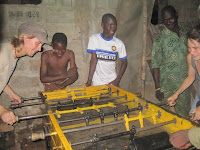
After a few days more in Benin, where we saw some museums about the slave trade and the history of Benin, we returned back to Ghana. The primary means of transportation in both Togo and Benin for shorter distances are s
mall moto-taxis (locally known as zem-zem’s). It’s essentially a motorbike that works as a taxi. Even though it’s a bit problematic to take them if it’s raining (since you get soaking wet), and can at times be dangerous(old Chinese bikes on shitty roads – do the math) – I find it one of the best ways to see the country. You have a full free sight and get to see a lot of small things a


Trip to Volta Region
This weekend the quartet united again for a trip to the Volta Region.
Friday was spent kayaking the Volta River. We found a place run by a friendly Dutch guy and rented some kayaks there. Fantastic trip. There’s nothing better than kayaking on a tropical river in fantastic weather.
The next day we spent and the Wli falls. One of the major tourist attractions in Ghana. After a 30 minutes walk through some of the most beautiful scenery I’ve seen so far in Ghana, we reached a big awesome waterfall. (We of course went swimming under. What else would you do?). Also - the waterfall was surrounded by bats. When some Togolese hunter (the fall is right on the Togolese border) shot his gun (don’t ask me why people hunt bats with guns) more than a thousand bats flew away from the walls and into the sky. A completely unbelievable sight.
I’ll try to upload some pictures soon. But yeah – it was epic!
Life in Ghana
In more general terms life in Ghana is good. Food here is really cheap and even though it’s good, it becomes a bit boring in the long run. Variety is what I’m lacking. Oh – and good meat. All meat here(if you can find any) is chopped up in what seems like random pieces and the boiled in a big stew. You rarely see steaks or any other sort of “pure” meat. What you do see is lots of fish lying on the shelves that looks like it was cooked/fried/boiled/smoked yesterday. I’m not too big on warm fish that has been lying for more than two days. But hey – who cares when they have amazing pineapple! Hurray!
Oh – and classes are cancelled today. Teachers apparently went on strike. No one knows how long it will last. Some say a week, some say a day, some say perhaps two weeks. When they had a similar strike in ‘95 it lasted a year. Lets hope it doesn’t last that long this time. It’s apparently something about wages (what else to strike over?). But yeah – it’s not going to make a big difference. Most lectures are quite useless anyways. I will rely on the books (have books for 3 of 5 classes now) and the copies of past exams. Since I only need to pass I should have a fair chance.
This weekend the quartet united again for a trip to the Volta Region.
Friday was spent kayaking the Volta River. We found a place run by a friendly Dutch guy and rented some kayaks there. Fantastic trip. There’s nothing better than kayaking on a tropical river in fantastic weather.
The next day we spent and the Wli falls. One of the major tourist attractions in Ghana. After a 30 minutes walk through some of the most beautiful scenery I’ve seen so far in Ghana, we reached a big awesome waterfall. (We of course went swimming under. What else would you do?). Also - the waterfall was surrounded by bats. When some Togolese hunter (the fall is right on the Togolese border) shot his gun (don’t ask me why people hunt bats with guns) more than a thousand bats flew away from the walls and into the sky. A completely unbelievable sight.
I’ll try to upload some pictures soon. But yeah – it was epic!
Life in Ghana
In more general terms life in Ghana is good. Food here is really cheap and even though it’s good, it becomes a bit boring in the long run. Variety is what I’m lacking. Oh – and good meat. All meat here(if you can find any) is chopped up in what seems like random pieces and the boiled in a big stew. You rarely see steaks or any other sort of “pure” meat. What you do see is lots of fish lying on the shelves that looks like it was cooked/fried/boiled/smoked yesterday. I’m not too big on warm fish that has been lying for more than two days. But hey – who cares when they have amazing pineapple! Hurray!
Oh – and classes are cancelled today. Teachers apparently went on strike. No one knows how long it will last. Some say a week, some say a day, some say perhaps two weeks. When they had a similar strike in ‘95 it lasted a year. Lets hope it doesn’t last that long this time. It’s apparently something about wages (what else to strike over?). But yeah – it’s not going to make a big difference. Most lectures are quite useless anyways. I will rely on the books (have books for 3 of 5 classes now) and the copies of past exams. Since I only need to pass I should have a fair chance.
(And here is a picture of me with a beautiful helmet from a mountain bike ride last week!)

Sunday, September 26, 2010
The Doxy Effect
Malaria is a horrifying disease - especially if you don’t treat it and don’t have any natural resistance (Like most white people don’t).
To solve this problem of getting deadly sick, most people take what is known as “Malaria-Prophylaxis” or more commonly known as “Malaria-Pills”. There are several kinds/compounds/drugs/brands on the market and they all the various pro’s and con’s.
Lariam (Mefloquine) is effective, fairly cheap, needs to be taken only once a week, but the side effects range from nightmares to paranoia, depression and schizophrenia.
Malarone, which is the newest and most recommended drug, is taken once a day, very effective, very few side effects – but a single pill (daily dose) costs around 6$(30dkr). Multiply that by 5 months and you are at $900(4.500dkr). Money I would rather spend elsewhere.
The final choice is Doxycycline. It’s actually an antibiotic – but seems to work as a Malaria Preventative Pill as well. You take 1 pill a day, lower dosage (100mg) than if you were treating a disease. Side effects include: sunburn and photosensitivity (though I haven’t felt anything yet) – and of course the problems that might come up from taking antibiotics non-stop for 5 months. But!: The prices for 5 months is $24(130dkr). And here comes the interesting part:
If you Google Doxycycline uses, the following things come up:
• Treatment of bacterial infections
• Acne treatment
• An alternative for the prevention of malaria
• Treatment of anthrax infections
• Treatment of rosacea
• Treatment of periodontitis (gum disease).
Bacterial Infections
Doxycycline can be used to treat a number of different types of infections caused by bacteria. It is most commonly used to treat infections such as:
• Certain types of pneumonia
• Chlamydia
• Rocky Mountain spotted fever
• Typhus fever
• Tick fever
• Syphilis (when unable to take penicillin)
• Some respiratory or urinary tract infections (UTIs)
• Plague
• Cholera
• Tularemia
• Gonorrhea
• Lyme disease.
Essentially, doxy is protecting me from a whole range of diseases (or at least that is what I like to tell myself). Kaisa had Typhoid Fever a few weeks ago – but I like to tell myself that due to the Doxy-Effect, I did not get it – since the vicious Doxy-drug butchered any typhoid bacteria that might have entered my system. (or my vaccination against typhoid worked).
I’m not a doctor – so I don’t know if this is actually true. Can antibiotics be used as a prophylaxis against say – bacterial infections from wounds and food?
If it can – well, that’s the Doxy Effect for you. The best externality Malaria-Prophylaxis can get you!
To solve this problem of getting deadly sick, most people take what is known as “Malaria-Prophylaxis” or more commonly known as “Malaria-Pills”. There are several kinds/compounds/drugs/brands on the market and they all the various pro’s and con’s.
Lariam (Mefloquine) is effective, fairly cheap, needs to be taken only once a week, but the side effects range from nightmares to paranoia, depression and schizophrenia.
Malarone, which is the newest and most recommended drug, is taken once a day, very effective, very few side effects – but a single pill (daily dose) costs around 6$(30dkr). Multiply that by 5 months and you are at $900(4.500dkr). Money I would rather spend elsewhere.
The final choice is Doxycycline. It’s actually an antibiotic – but seems to work as a Malaria Preventative Pill as well. You take 1 pill a day, lower dosage (100mg) than if you were treating a disease. Side effects include: sunburn and photosensitivity (though I haven’t felt anything yet) – and of course the problems that might come up from taking antibiotics non-stop for 5 months. But!: The prices for 5 months is $24(130dkr). And here comes the interesting part:
If you Google Doxycycline uses, the following things come up:
• Treatment of bacterial infections
• Acne treatment
• An alternative for the prevention of malaria
• Treatment of anthrax infections
• Treatment of rosacea
• Treatment of periodontitis (gum disease).
Bacterial Infections
Doxycycline can be used to treat a number of different types of infections caused by bacteria. It is most commonly used to treat infections such as:
• Certain types of pneumonia
• Chlamydia
• Rocky Mountain spotted fever
• Typhus fever
• Tick fever
• Syphilis (when unable to take penicillin)
• Some respiratory or urinary tract infections (UTIs)
• Plague
• Cholera
• Tularemia
• Gonorrhea
• Lyme disease.
Essentially, doxy is protecting me from a whole range of diseases (or at least that is what I like to tell myself). Kaisa had Typhoid Fever a few weeks ago – but I like to tell myself that due to the Doxy-Effect, I did not get it – since the vicious Doxy-drug butchered any typhoid bacteria that might have entered my system. (or my vaccination against typhoid worked).
I’m not a doctor – so I don’t know if this is actually true. Can antibiotics be used as a prophylaxis against say – bacterial infections from wounds and food?
If it can – well, that’s the Doxy Effect for you. The best externality Malaria-Prophylaxis can get you!
Thursday, September 23, 2010
"Obruni Magic”
“Obruni” is the Twi (local language in southern Ghana) word for “white person” or “foreigner”. Wherever we go we are always addressed as “Obruni”. The sales women will yell, “Hey Obruni – what do you want”. People on the street will say “Hey Obruni”, and all the children I come by always yell “Obruni, Obruni, Obruni” while waving aggressively.
Usually when I’m out in town or just playing with all the kids, who hang out at the night market close to my building, I’ll do one of my two magic tricks that I’m really proud of. They are both very simply, but advanced enough to trick a 5-year old, which I find great amusement in (you have no idea how much street respect you get from doing magic in a quite superstitious society). One of the tricks is an old one my dad used to do when I was a kid. It involves me removing my thumb and then reattaching it again. It looks quiet real – but works best on children. (For some reason most grown-ups are too smart).
The other trick, which I do more frequently and in several variants, is the “make the coin disappear-trick”. I’ll take a coin (or a stone), put it in my hand, close my hand and make it disappear. The kids usually scream and look very surprised when I open my hand and the stone is not there anymore.
This has made some of the local kids give me the nickname “Obruni-Magic” – which I find quite funny and amusing. Not that I consider myself very magical – but if I can entertain some kids and make them laugh – my day is saved.
My two tricks have also found many uses beyond our little Accra World. Whenever we travel and meet some kids, I always pull one of them off. Almost always the reaction is surprise, joy and excitement. Very entertaining. It in someway proves that children all around the world are basically the same. They all love to play an have fun.
My magic skills were also used a lot on some of the longer journeys in 2009 in Sierra Leone. I remember once when Clem and I got stuck in a little tiny village, cause out motorbike ran out of fuel. The driver borrowed a regular bicycle and biked 2 hours back-and-forth to the nearest village to get some fuel. In the meantime we entertained the entire village with magic and - despite the language barrier - made very good friends with the elders and the people not out working the fields.
So yeah – if you ever come to Ghana and hear someone yell “Obruni Magic” – I’m probably not far away. (Or someone copied my tricks!)
Usually when I’m out in town or just playing with all the kids, who hang out at the night market close to my building, I’ll do one of my two magic tricks that I’m really proud of. They are both very simply, but advanced enough to trick a 5-year old, which I find great amusement in (you have no idea how much street respect you get from doing magic in a quite superstitious society). One of the tricks is an old one my dad used to do when I was a kid. It involves me removing my thumb and then reattaching it again. It looks quiet real – but works best on children. (For some reason most grown-ups are too smart).
The other trick, which I do more frequently and in several variants, is the “make the coin disappear-trick”. I’ll take a coin (or a stone), put it in my hand, close my hand and make it disappear. The kids usually scream and look very surprised when I open my hand and the stone is not there anymore.
This has made some of the local kids give me the nickname “Obruni-Magic” – which I find quite funny and amusing. Not that I consider myself very magical – but if I can entertain some kids and make them laugh – my day is saved.
My two tricks have also found many uses beyond our little Accra World. Whenever we travel and meet some kids, I always pull one of them off. Almost always the reaction is surprise, joy and excitement. Very entertaining. It in someway proves that children all around the world are basically the same. They all love to play an have fun.
My magic skills were also used a lot on some of the longer journeys in 2009 in Sierra Leone. I remember once when Clem and I got stuck in a little tiny village, cause out motorbike ran out of fuel. The driver borrowed a regular bicycle and biked 2 hours back-and-forth to the nearest village to get some fuel. In the meantime we entertained the entire village with magic and - despite the language barrier - made very good friends with the elders and the people not out working the fields.
So yeah – if you ever come to Ghana and hear someone yell “Obruni Magic” – I’m probably not far away. (Or someone copied my tricks!)
Friday, September 10, 2010
Water in a bag, Typhoid Fever, How to send an e-mail and other peculiarities.
Water in a bag is an extremely practical invention. Instead of buying a bottle, you buy water in a small plastic bag (locally known as sachet-water). The water from the tap is not clean enough for drinking, so you have to rely on purified water for drinking unless you want to experiment with all kinds of waterborne diseases and stomach problems. A 1L water bottle cost 1 Cedi (80US Cent, 4 Kr) and a bag of 30 Sachets with 400ml in each cost 1.35 Cedi. A lot of money to save. Plus, they are super convenient. So cool. Maybe I should try to introduce those back home. Wonder if they would be a success?
Last weekend was a stay-at-home-weekend. I spent most of my time trying to catch up with some homework. The plan was to go to Benin this weekend and take advantage of our 30 day visa for Togo. (you have to cross Togo to enter Benin, unless you want to travel 2000 Km around Togo).
Unfortunately Kaisa wasn’t feeling too good this Tuesday. She had a lot of stomach pain so decided to go to the hospital to have a check up. It turned out she had gotten typhoid fever. It sounds a lot worse than it is. Yes, she was sick and spent 2 days in bed. But the disease is easily treatable with antibiotics and if it is treated it is not much worse than a small flue. Typhoid is transferred when you eat something that has been in touch with human feces from a person who had typhoid fever. Essentially it’s important that you avoid eating shit – or make sure that the people who cook you food wash their hands before cooking – and that you make sure to wash your own hands before eating (its here the golden invention of Hand Sanitizer comes into the picture).
Last night Kaisa was already feeling better, and came by my room and hung out for a while. Hopefully she’ll be fully fine by Monday – so she’s ready to leave for Benin next Thursday.
School have been relaxing so far. It is not always the most challenging classes, yet almost always very interesting. In two of my classes (out of 5), I’m the only white/foreign student. Sometimes feels a bit weird sitting in a classroom with 200 Ghanaians and being the only white person. Especially because you really can’t hide. Fortunately the teacher in that class is really nice, even though he keeps asking me questions in front of the entire class (which is really awkward!)
Oh – and I got homework this week. My homework consists of sending an e-mail. Jep, in one of my other classes the professor asked everyone to send him an e-mail, to show him that we knew how to send e-mails. Such a different world. Think I sent my first e-mail in 1999, when I was in the US on a CISV camp. More than 11 years ago – and now we are asked (in a 4th year university course) to send one has homework. Just so different.
I’ve also got a group project for another class. One of the group members had never heard of Wikipedia. When you think about it, it’s not that strange –but for me as a student it was still quite surprising. (Just for the record, the project is actually a “real project” we have to write a 4 page critique of the modernization theory).
Having mentioned that, I have to underline that even though there are several computer cafes on campus, and many students do have computers.. However I yet have to see one bring a laptop to class (which is not the norm in Canada). I have thought a bit of brining mine, but I think it would be strange since no one else does it. Even though I miss being able to look up words or facts on the spot – as the lecture goes on.
So yeah all is well. I even started swimming. Me swimming? I know – it’s hard to believe. Me swimming? But they’ve got this 50meters (Olympic size) pool 5 minutes walk from my residence. And for the majority of the time, the pool is completely empty – so I’ve got the entire pool to myself. Quite ideal for swimming. It’s especially nice when you are all soaked in sweat and the temperature reaches 30 degrees with insanely high humidity.
Last weekend was a stay-at-home-weekend. I spent most of my time trying to catch up with some homework. The plan was to go to Benin this weekend and take advantage of our 30 day visa for Togo. (you have to cross Togo to enter Benin, unless you want to travel 2000 Km around Togo).
Unfortunately Kaisa wasn’t feeling too good this Tuesday. She had a lot of stomach pain so decided to go to the hospital to have a check up. It turned out she had gotten typhoid fever. It sounds a lot worse than it is. Yes, she was sick and spent 2 days in bed. But the disease is easily treatable with antibiotics and if it is treated it is not much worse than a small flue. Typhoid is transferred when you eat something that has been in touch with human feces from a person who had typhoid fever. Essentially it’s important that you avoid eating shit – or make sure that the people who cook you food wash their hands before cooking – and that you make sure to wash your own hands before eating (its here the golden invention of Hand Sanitizer comes into the picture).
Last night Kaisa was already feeling better, and came by my room and hung out for a while. Hopefully she’ll be fully fine by Monday – so she’s ready to leave for Benin next Thursday.
School have been relaxing so far. It is not always the most challenging classes, yet almost always very interesting. In two of my classes (out of 5), I’m the only white/foreign student. Sometimes feels a bit weird sitting in a classroom with 200 Ghanaians and being the only white person. Especially because you really can’t hide. Fortunately the teacher in that class is really nice, even though he keeps asking me questions in front of the entire class (which is really awkward!)
Oh – and I got homework this week. My homework consists of sending an e-mail. Jep, in one of my other classes the professor asked everyone to send him an e-mail, to show him that we knew how to send e-mails. Such a different world. Think I sent my first e-mail in 1999, when I was in the US on a CISV camp. More than 11 years ago – and now we are asked (in a 4th year university course) to send one has homework. Just so different.
I’ve also got a group project for another class. One of the group members had never heard of Wikipedia. When you think about it, it’s not that strange –but for me as a student it was still quite surprising. (Just for the record, the project is actually a “real project” we have to write a 4 page critique of the modernization theory).
Having mentioned that, I have to underline that even though there are several computer cafes on campus, and many students do have computers.. However I yet have to see one bring a laptop to class (which is not the norm in Canada). I have thought a bit of brining mine, but I think it would be strange since no one else does it. Even though I miss being able to look up words or facts on the spot – as the lecture goes on.
So yeah all is well. I even started swimming. Me swimming? I know – it’s hard to believe. Me swimming? But they’ve got this 50meters (Olympic size) pool 5 minutes walk from my residence. And for the majority of the time, the pool is completely empty – so I’ve got the entire pool to myself. Quite ideal for swimming. It’s especially nice when you are all soaked in sweat and the temperature reaches 30 degrees with insanely high humidity.
Tuesday, August 31, 2010
To go to Togo
Funny right? If you say Togo slowly it sounds like “To Go”. Ok, actually it’s not that funny. But it gave us a good laugh. Spent the weekend in Togo. Very interesting and different country.
I traveled with Kaisa, Rochelle and Jessica. So the same quartet I traveled with to Cape Coast last weekend.
I studied with Kaisa and Rochelle in Canada at Simon Fraser University. They are both UWC’ers. Rochelle and I also studied together in Norway, so we’ve known each other for a while. Jessica is Canadian, studies in Montreal and speaks French. A good skill to have when going to a Francophone country.
So off we went in a little “Tro-Tro” (Mini vans with rows of homemade seats, functioning as a bus) to the Togolese border. The rural areas of Ghana are significantly poorer than Accra, yet still more developed than Sierra Leone. The road was paved all the way, and most villages and cities had electricity. A thing Togo did not. Not even in Lomé, the Capital.
We made it to Togo about 5pm. The border crossing was a joke. The Togolese immigration office consists of two tables standing under a small thatched roof. I wasn’t allowed to take a picture, but it was so strange. Standing there in the open filling out Visa forms. We filled out our papers and paid the 10.000 West African Francs the Visa cost. In most (all?) Francophone countries in West Africa they use the same currency, the West African Franc, which should make trade and traveling between the countries a lot easier (haven’t tried myself yet – so can’t tell for sure).
Lomé is essentially on the border – which meant we could walk from the border to our hostel. Quite convenient.
People in Togo are very friendly, and in many ways less harassing and direct than people in Ghana. Personally I was not too comfortable with the country in the beginning, but I think it mainly stems from the fact that I don’t speak French (and hate admitting to people that I don’t speak their language). It makes you feel very handicapped, when you have no clue what people are telling you. Not sure how we would have survived without Jessica’s help in a country where people barely speaks English.
About Lomé: It is a lot smaller than Accra, but still in some respects a very beautiful city. Unfortunately due to several years of political unrest and bad economic policies the cities has been allowed to fade. You can sense that it used to be a grand and magnificent city once upon a time. Which sadly enough is the feeling you get in many African cities. Things where built in better times, but never maintained.
In on the Friday in Lomé we visited a Fetish (in the French meaning of the word – i.e. “object of spiritual meaning” or something like that) market. Many people in Togo still swear to the old traditional beliefs. A part of this belief involves buying lots of small articles to protect yourself and your house and to cure you from diseases and curses. Some of these things are quite obscure. How about the head of a monkey? Or what about the claw of an eagle? For not to mention the shell of a turtle, the skin of a leopard, a horse skull, some snake skin, or maybe just a dead owl on a stick. . . .?
(They wanted money for pictures, so unfortunately I don’t have any, but there are a few good ones here: http://news.bbc.co.uk/2/shared/spl/hi/picture_gallery/05/africa_togo0s_voodoo_market/html/1.stm and here: http://www.flickr.com/photos/pritheworld/3351359593/in/photostream/ )
We went to see the “chief/medicine man” who told us about these small items with magical properties (which he of course tried to sell us): The ebony fruit/nut makes you sleep better if blessed by the chief, the telephone fetish (little piece of pink wood), provides safe travels if you whisper in it and so on. Could not really make up my mind as to whether this was a tourist scam or whether people really believed in it – but interesting non the less. Yet , it didn’t really seem like a place many tourists came. The market was too hard to find, and too big to only survive on tourism.
Saturday morning we went to a West African Art/Culture museum. The museum was founded by a Swiss anthropologist who wanted to give African Art back to Africa. He has spent the last couple of years traveling in West Africa collecting old cultural items and art pieces. A few years ago he opened his private collection to the public, essentially turning it into a museum. Very interesting to see all the strange and different statues, bracelets, helmets etc that the various cultures used for ceremonies.
After the museum trip we bargained with a cab driver and made him drive us 2 hours north to the city Kpalimé (pronounced Palime), for the same price the bus would have cost us.
Kpalimé is very different from Lomé and a lot smaller. Located in a lush green region of hills and cocoa farmers it is the center of agricultural commerce in Togo. This was very visible from the fantastic agricultural market in the center of the village. Fruits, vegetables and spices everywhere. In addition the beautiful location, the people were a lot more friendly and relaxed (Perhaps, more a country-side mentality than a clear cultural difference).
We spent the night in Kpalimé. Sunday morning we did a hike in the beautiful countryside. We simply caught a ride 20 minutes out of town where we found a little path, which we followed it up along a mountainside. On out little hike, between banana and mango trees, we found a ripe cocoa that we shared next to a little waterfall. Not the worst lunch. On the way back we must have touched some poisonous tree or bush, cause all of us had red spots on our arms and legs (We are all still alive).
When we got back to Kpalimé we caught the oldest and most rusty car I’ve ever seen in my life to the Ghanaian border (100km North of Lomé). Here the Ghanaian border officials joked with us and took down out names from the Declaration Card so they could find us on Facebook. They also wanted our numbers. I took down one guy’s number, and when I didn’t to call him later that night, he called me monday morning and complained. (He must have taken my number off the Declaration Card!) A little weird, but a normality by now. Many people want to make “professional friends” with you. He called me and asked how I was and said he would call when he came to Accra so we could meet. I spoke to the guy for about 1 minute when I filled out the declaration form. Not the way I usually make friends.
We however made it safely back to Accra with a Tro-Tro sunday night, and all in all had a great trip to Togo. Bon Voyage!
I traveled with Kaisa, Rochelle and Jessica. So the same quartet I traveled with to Cape Coast last weekend.
I studied with Kaisa and Rochelle in Canada at Simon Fraser University. They are both UWC’ers. Rochelle and I also studied together in Norway, so we’ve known each other for a while. Jessica is Canadian, studies in Montreal and speaks French. A good skill to have when going to a Francophone country.
So off we went in a little “Tro-Tro” (Mini vans with rows of homemade seats, functioning as a bus) to the Togolese border. The rural areas of Ghana are significantly poorer than Accra, yet still more developed than Sierra Leone. The road was paved all the way, and most villages and cities had electricity. A thing Togo did not. Not even in Lomé, the Capital.
We made it to Togo about 5pm. The border crossing was a joke. The Togolese immigration office consists of two tables standing under a small thatched roof. I wasn’t allowed to take a picture, but it was so strange. Standing there in the open filling out Visa forms. We filled out our papers and paid the 10.000 West African Francs the Visa cost. In most (all?) Francophone countries in West Africa they use the same currency, the West African Franc, which should make trade and traveling between the countries a lot easier (haven’t tried myself yet – so can’t tell for sure).
Lomé is essentially on the border – which meant we could walk from the border to our hostel. Quite convenient.
People in Togo are very friendly, and in many ways less harassing and direct than people in Ghana. Personally I was not too comfortable with the country in the beginning, but I think it mainly stems from the fact that I don’t speak French (and hate admitting to people that I don’t speak their language). It makes you feel very handicapped, when you have no clue what people are telling you. Not sure how we would have survived without Jessica’s help in a country where people barely speaks English.
About Lomé: It is a lot smaller than Accra, but still in some respects a very beautiful city. Unfortunately due to several years of political unrest and bad economic policies the cities has been allowed to fade. You can sense that it used to be a grand and magnificent city once upon a time. Which sadly enough is the feeling you get in many African cities. Things where built in better times, but never maintained.
In on the Friday in Lomé we visited a Fetish (in the French meaning of the word – i.e. “object of spiritual meaning” or something like that) market. Many people in Togo still swear to the old traditional beliefs. A part of this belief involves buying lots of small articles to protect yourself and your house and to cure you from diseases and curses. Some of these things are quite obscure. How about the head of a monkey? Or what about the claw of an eagle? For not to mention the shell of a turtle, the skin of a leopard, a horse skull, some snake skin, or maybe just a dead owl on a stick. . . .?
(They wanted money for pictures, so unfortunately I don’t have any, but there are a few good ones here: http://news.bbc.co.uk/2/shared/spl/hi/picture_gallery/05/africa_togo0s_voodoo_market/html/1.stm and here: http://www.flickr.com/photos/pritheworld/3351359593/in/photostream/ )
We went to see the “chief/medicine man” who told us about these small items with magical properties (which he of course tried to sell us): The ebony fruit/nut makes you sleep better if blessed by the chief, the telephone fetish (little piece of pink wood), provides safe travels if you whisper in it and so on. Could not really make up my mind as to whether this was a tourist scam or whether people really believed in it – but interesting non the less. Yet , it didn’t really seem like a place many tourists came. The market was too hard to find, and too big to only survive on tourism.
Saturday morning we went to a West African Art/Culture museum. The museum was founded by a Swiss anthropologist who wanted to give African Art back to Africa. He has spent the last couple of years traveling in West Africa collecting old cultural items and art pieces. A few years ago he opened his private collection to the public, essentially turning it into a museum. Very interesting to see all the strange and different statues, bracelets, helmets etc that the various cultures used for ceremonies.
After the museum trip we bargained with a cab driver and made him drive us 2 hours north to the city Kpalimé (pronounced Palime), for the same price the bus would have cost us.
Kpalimé is very different from Lomé and a lot smaller. Located in a lush green region of hills and cocoa farmers it is the center of agricultural commerce in Togo. This was very visible from the fantastic agricultural market in the center of the village. Fruits, vegetables and spices everywhere. In addition the beautiful location, the people were a lot more friendly and relaxed (Perhaps, more a country-side mentality than a clear cultural difference).
We spent the night in Kpalimé. Sunday morning we did a hike in the beautiful countryside. We simply caught a ride 20 minutes out of town where we found a little path, which we followed it up along a mountainside. On out little hike, between banana and mango trees, we found a ripe cocoa that we shared next to a little waterfall. Not the worst lunch. On the way back we must have touched some poisonous tree or bush, cause all of us had red spots on our arms and legs (We are all still alive).
When we got back to Kpalimé we caught the oldest and most rusty car I’ve ever seen in my life to the Ghanaian border (100km North of Lomé). Here the Ghanaian border officials joked with us and took down out names from the Declaration Card so they could find us on Facebook. They also wanted our numbers. I took down one guy’s number, and when I didn’t to call him later that night, he called me monday morning and complained. (He must have taken my number off the Declaration Card!) A little weird, but a normality by now. Many people want to make “professional friends” with you. He called me and asked how I was and said he would call when he came to Accra so we could meet. I spoke to the guy for about 1 minute when I filled out the declaration form. Not the way I usually make friends.
We however made it safely back to Accra with a Tro-Tro sunday night, and all in all had a great trip to Togo. Bon Voyage!
Tuesday, August 24, 2010
Leapfrogging Development: Mobile Banking
For those new to the phenomena I’ll try to explain it briefly:
In most “Developing” countries cell phones works through a “top-up” system. You simply buy a little voucher off one of the street vendors who stands at basically every corner, and use this voucher to add credit to your phone. Or – you pay a vender to “send” you credits electronically. (The vender will send credits from his phone to your phone).
At some point people figured out that this “credit” could also be used as a currency. So instead of paying people in cash, they paid in “credit”. They simply sent credits from their cell to the salesperson’s cell, when they purchased something. This means that people do not have to carry cash, which in an almost purely cash based economy is a major step forward.
Yet, the true ingenuity with mobile banking is the transfer of credit (money) between relatives. In many African countries family members often live far apart. Perhaps the dad is a seasonal migrant worker, or the mother moved to the city to see that the kids could go to school. For whatever reason family members often live far apart. Earlier this meant that transporting money was a tedious process.
To continue with our example:
Imagine the husband seeking work in the city, while leaving the family behind in the rural areas. In the city there are better work opportunities and higher wages. Earlier, when he wanted to send remittances (money) back to his dependants (children, wife etc), he would either have to give up a few days of work and travel all the way home with a big stack of cash. In this way he did not only loose valuable days of work, but traveling with a big stack of cash is not very safe in countries where poverty is widespread and theft or pick pocketing happens on a wide basis. With mobile banking, he can simply send the money back home electronically.
Since the start of just sending “credits”, the system has developed so you now have a separate mobile bank on your phone. I added 10Cedi (about 8 USD) to my account. When I owed my friend Kaisa 2 Cedi, I simply sent them to her from my phone. If you need to cash to the money, you simply drop by one of the many official venders or co-operating banks and send them your money, which they in turn will give you as cash. Brilliant right?
In most “Developing” countries cell phones works through a “top-up” system. You simply buy a little voucher off one of the street vendors who stands at basically every corner, and use this voucher to add credit to your phone. Or – you pay a vender to “send” you credits electronically. (The vender will send credits from his phone to your phone).
At some point people figured out that this “credit” could also be used as a currency. So instead of paying people in cash, they paid in “credit”. They simply sent credits from their cell to the salesperson’s cell, when they purchased something. This means that people do not have to carry cash, which in an almost purely cash based economy is a major step forward.
Yet, the true ingenuity with mobile banking is the transfer of credit (money) between relatives. In many African countries family members often live far apart. Perhaps the dad is a seasonal migrant worker, or the mother moved to the city to see that the kids could go to school. For whatever reason family members often live far apart. Earlier this meant that transporting money was a tedious process.
To continue with our example:
Imagine the husband seeking work in the city, while leaving the family behind in the rural areas. In the city there are better work opportunities and higher wages. Earlier, when he wanted to send remittances (money) back to his dependants (children, wife etc), he would either have to give up a few days of work and travel all the way home with a big stack of cash. In this way he did not only loose valuable days of work, but traveling with a big stack of cash is not very safe in countries where poverty is widespread and theft or pick pocketing happens on a wide basis. With mobile banking, he can simply send the money back home electronically.
Since the start of just sending “credits”, the system has developed so you now have a separate mobile bank on your phone. I added 10Cedi (about 8 USD) to my account. When I owed my friend Kaisa 2 Cedi, I simply sent them to her from my phone. If you need to cash to the money, you simply drop by one of the many official venders or co-operating banks and send them your money, which they in turn will give you as cash. Brilliant right?
Monday, August 23, 2010
Ghana: A Developing Country….or?
The obvious answer to this question is “yes”. Ghana is a developing country by all means. A very fast developing country in fact.
Which in many ways challenge the way people think of “Developing Countries”. Many developing countries fail to develop all together, why the use of the word “developing” (though politically correct) is somewhat misleading.
A more suitable question to ask would be something along the lines of: Is Ghana a hopelessly lost economically stagnant country, caught in a poverty trap with no or few good prospects for the future? Absolutely not.
In many ways Ghana reminds me more of Central America ( e.g. Honduras or Nicaragua) than of Sierra Leone, which I have previously visited. Granted, Sierra Leone is one of the poorest countries on the earth, but the difference is still striking and serves as an important reminder that box-categorizing sub-Saharan Africa as “Poor” is wildly misleading. Africa has more than 50 countries. Putting them all into the same category is not only very simplistic, but also rarely useful when talking about development.
So back to Ghana:
All the roads are paved. There are streetlights almost everywhere. Reliable electricity. Cell phone connectivity is impressive. EVERYONE has a cell phone, and there are 4 or 5 major companies competing for customers. Recently “Mobile Banking” made it to Ghana. Though it is not yet used on a wide basis, the concept is still interesting. For more on that you’ll have to wait on my next post, which (for sure) will be about mobile banking.
I have still only seen few parts of the country, (have not yet been to the north, which is suppose to be the “poor” part) but so far things seem to be moving at insane speed. There are building projects going on all over Ghana. Hotels, Malls, Office Centres. Everything. While most of the billboards next to the central roads leading from my university into Accra advertise for cheap cell phone deals, some advertise for everything from Birkenstock Sandals(which are now sold at the newly built Accra Mall), to Ford Escape. This indicates that the middle class has now grown big enough to demand these things.
It is however also a fact that there is a great inequality in Ghana. If you are rich you are often superrich and being poor is still not happy times, yet literacy rates for 15-24 years olds are still above 75% (in 2005 – probably higher now) and primary school enrollment is free and is attended by more than 90% of both genders.
All this is positive news and definitely great for the country. In general I also feel a very positive vibe from people down here.
The mood is generally high, people are really friendly and helpful and I feel very safe and secure walking around most places.
The other night we spoke to a Ghanaian woman who started her own company helping NGO’s carry out there projects. She told us about a school where the kids sat on benches, and her suggestion was to find chairs with backrests to the children so they could sit better.
This in many ways hit me as good news. I mean, ok – its sad that the children are sitting a benches. But if that’s their biggest problem, then I’d say they’re doing rather well.
But yeah, I guess the situation looks somewhat different when I make it to the rural areas in the north. I’ll fill you in on that when I get there.
Currently planning a trip to Togo for the coming weekend. Hopefully we’ll be able to get a Visa from the border. My biggest task at the moment is to find someone who speaks French who I can bring along – cause my French is basically non-existent.
Which in many ways challenge the way people think of “Developing Countries”. Many developing countries fail to develop all together, why the use of the word “developing” (though politically correct) is somewhat misleading.
A more suitable question to ask would be something along the lines of: Is Ghana a hopelessly lost economically stagnant country, caught in a poverty trap with no or few good prospects for the future? Absolutely not.
In many ways Ghana reminds me more of Central America ( e.g. Honduras or Nicaragua) than of Sierra Leone, which I have previously visited. Granted, Sierra Leone is one of the poorest countries on the earth, but the difference is still striking and serves as an important reminder that box-categorizing sub-Saharan Africa as “Poor” is wildly misleading. Africa has more than 50 countries. Putting them all into the same category is not only very simplistic, but also rarely useful when talking about development.
So back to Ghana:
All the roads are paved. There are streetlights almost everywhere. Reliable electricity. Cell phone connectivity is impressive. EVERYONE has a cell phone, and there are 4 or 5 major companies competing for customers. Recently “Mobile Banking” made it to Ghana. Though it is not yet used on a wide basis, the concept is still interesting. For more on that you’ll have to wait on my next post, which (for sure) will be about mobile banking.
I have still only seen few parts of the country, (have not yet been to the north, which is suppose to be the “poor” part) but so far things seem to be moving at insane speed. There are building projects going on all over Ghana. Hotels, Malls, Office Centres. Everything. While most of the billboards next to the central roads leading from my university into Accra advertise for cheap cell phone deals, some advertise for everything from Birkenstock Sandals(which are now sold at the newly built Accra Mall), to Ford Escape. This indicates that the middle class has now grown big enough to demand these things.
It is however also a fact that there is a great inequality in Ghana. If you are rich you are often superrich and being poor is still not happy times, yet literacy rates for 15-24 years olds are still above 75% (in 2005 – probably higher now) and primary school enrollment is free and is attended by more than 90% of both genders.
All this is positive news and definitely great for the country. In general I also feel a very positive vibe from people down here.
The mood is generally high, people are really friendly and helpful and I feel very safe and secure walking around most places.
The other night we spoke to a Ghanaian woman who started her own company helping NGO’s carry out there projects. She told us about a school where the kids sat on benches, and her suggestion was to find chairs with backrests to the children so they could sit better.
This in many ways hit me as good news. I mean, ok – its sad that the children are sitting a benches. But if that’s their biggest problem, then I’d say they’re doing rather well.
But yeah, I guess the situation looks somewhat different when I make it to the rural areas in the north. I’ll fill you in on that when I get there.
Currently planning a trip to Togo for the coming weekend. Hopefully we’ll be able to get a Visa from the border. My biggest task at the moment is to find someone who speaks French who I can bring along – cause my French is basically non-existent.
Sunday, August 22, 2010
Two Weeks in Ghana
I’ve now been in Ghana for exactly two weeks. On the one hand it feels like time has flown by at amazing pace, on the other hand I’ve experienced so much that it feels like I’ve been here a lot longer.
I spent the last 2 days at Cape Coast, which is a city 100km west down the coast from Accra. One of the oldest and biggest European Castles outside of Europe is located there. Pretty cool trip. Went with Rochelle and Kaisa, whom I study with in Canada and another girl we met who studies in Montreal.
Getting there was an interesting experience in itself. We went outside out hostel and found ourselves a “tro-tro”, which is a mini-van-turned-into-bus. The driver said he would drop of us off at a bus station, from were we would be able to catch another tro-tro to Cape Coast. And so we did. The moment we arrived at the bus station a friendly man guided us over to another waiting tro-tro, and we immediately jumped in a drove off towards the coast. Always more fun and convenient to drive in the small local buses, compared to the big and infrequent “public” busses. Though I have to admit that if the ride is any longer than 3 hours, sitting with your knee’s under your chin is not exactly comfortable. Even though the price is often less than half.
Touring the castle was a cool experience and it was really scary to see how the slaves were handled before they were sent off to the Americas and the Caribbean.
When we made it back to Ghana yesterday night, we just made it in time for the “Welcome Durbar”. An event put on by the international programs office to welcome all the new international students. Lots of good Ghanaian food and dances for entertainment. So yeah, all in all a good first two weeks.
Sunday, August 15, 2010
Akwaaba[Welcome] to Ghana
(Friday 13th August)
Blog is back up and running! Hurray! I’ll try to update as much as I can, but Internet down here is a joke. It makes the good old dial up 56k feel like a Ferrari. Non the less, I made it to Ghana and the first 6 days has passed without major problems.
Registering for Classes. . . .
Getting registered for classes is a task in itself. And I’ve spent most of the last week attempting to do exactly that. I was somewhat prepared for the heavy bureaucracy, but I must admit that it still surprised me a little bit. Paying for residence works like this: Find the one bank (out of 5) that has the right account. This in itself is a task, since no one really seems to know what bank it is. After trying 4 different banks I finally found the right bank. (Which I had gone to once before, where they told me I was at the wrong bank !?!?!). There I deposited my 819 USD in cash and got a nice receipt. This receipt I then had to bring to the University’s “Cash Office” on the other side of campus, who would issue a new receipt/”proof of payment”. This new receipt I then had to bring to the international office, take two copies, and get them to sign it. Finally I could take my signed 2nd receipt and hand it in at the front desk of my residence, thereby completing my residence payment. Seems pretty straightforward . . . Except for the fact that everyone tells you different things. But yeah, you learn to live with that.
I haven’t yet registered for classes either. But I managed to complete my “academic registration”. I think this means I’m now officially enrolled in the school. (?). I’ve also signed up for some courses with the departments (Jep, you have to go in person to the departments and sign up, plus register online on a special registration website).
Unfortunately, all the time tables are not up yet(even though classes officially start on Monday). So I can’t really sign up finally before I know what classes might clash. Quite inconvenient. But hey. No rush.
Ghana:
Except for that Ghana is great so far. People are really friendly and in general I feel that the part of Ghana I’ve seen so far has a really good vibe to it.
And in comparison to Sierra Leone, Ghana can almost be considered a developed country. They even have an Apple store at the local Mall. (Plus, they have traffic lights and they actually work!).
But its cheap no?...
I thought so, and many things indeed are. But many things, especially at the mall, are nowhere near cheap. In fact a lot of things are a lot cheaper in Denmark. I tried to find a cheap pot to do some cooking in. And that turned out to be impossible. In the end I settled with this cheap aluminum piece of crap, which ended up costing me 17 Cedi (12 USD/67kr). And trust me, its really a piece of Sh*t.
What next?
Once I’ve had a chance to see a bit more of the country and settle in a bit more, I’ll try to write some more interesting posts on the culture, and local economic conditions and general observations I make. Without revealing too much I can already now inform that a post about cell phones and mobile banking will soon come up. But I need to investigate a bit more on that.
That’s all for now. Stay tuned, and I’ll share some of the more spicy moments.
Wednesday, December 23, 2009
Merry Christmas from Caye Caulker!
Its already been six days, and in some ways I feel like its been two, cause I've had soo much fun. And on the other hand it feels like weeks, cause so much has happened.
Currently in Caye Caulker, a small island of the coast of Mainland Belize. For those who dont know about it, then the island is really small, has lots of cheap rum, white sandy beaches, palm trees and everyone here looks like they are taking out of a Bob Marley music video. Total Rasta Style. Its great.
prior to that, I had spent an entire night in Seattle airport talking to this american girl, Kristine, who was volunteering straight after highschool, through something called AmeriCorps, where you go to somewhere else in the states and volunteer. she was working in an elementary school in a poor area. really interesting midnight chat. Her monthly food budget was 60 USD and she didn't have any health insurance at all. She was just betting by on good luck. Quite weird for me to think about. |So yeah,m I finally caught my flight in the morning and made it off to cancun.
I spent 2 days in Cancun, which were quite dull so I need not elaborate here.
I then went south down the yucatan peninsula to a place called Tulum, where I spent two night. Had an awesome time there, went scuba diving in 2 cenotes. Cenotes are basically million year old sink-wholes or caves, with the most clean and clear water. Visibility is about 100m, which is extreme for scuba diving. a really cool experience diving around in this underground old caves with flashlights and checking out cool rock formations and Halocline and other interesting phenomena.
Monday i tried to make my way to belize. The border crossing is the slowest in the world. But a bit funny. at customs the rasta(yes, they had a full on rasta working with custusm) guy checked the bags of the guy before me, and then when i came he asked where I was going and whether I had any alcohol or tobacco on me, and I had to admit that I had half a bottle of rum -and asked if that was ok ..and he was like "yeah, fine go on". So no checking of my bag.
Anyways, we got delayed a lot, so we had to spend the night in belize city. by this time were were a group of 10 people who all met on the same bus and we were all going to caye caulker. So we joined together and found a nice guest house in an otherwise sketchy town. (belize city is quite a dodgy place, especially at night). We had a great time though and caught the boat here yesterday. spent the day on the beach, had lobster for dinner. Rum for desert, and more rum for midnight snack. its all in the rum . .
today we're going fishing and snorkeling with this local fisherman and tomorrow Im going to go on a big scuba trip to the blue whole. itll be great.
I cant be bothered(or afford) to send out individual emails to everyone, so if you read this, consider this a christmas greeting. internet here is SO slow and quite expensive.
Cheers!! and go slow. enjoy life!
ps. I hope some of this made sense, but its so warm in here and the sun is shining. so cant be asked to correct all my errors. ciao.
Currently in Caye Caulker, a small island of the coast of Mainland Belize. For those who dont know about it, then the island is really small, has lots of cheap rum, white sandy beaches, palm trees and everyone here looks like they are taking out of a Bob Marley music video. Total Rasta Style. Its great.
prior to that, I had spent an entire night in Seattle airport talking to this american girl, Kristine, who was volunteering straight after highschool, through something called AmeriCorps, where you go to somewhere else in the states and volunteer. she was working in an elementary school in a poor area. really interesting midnight chat. Her monthly food budget was 60 USD and she didn't have any health insurance at all. She was just betting by on good luck. Quite weird for me to think about. |So yeah,m I finally caught my flight in the morning and made it off to cancun.
I spent 2 days in Cancun, which were quite dull so I need not elaborate here.
I then went south down the yucatan peninsula to a place called Tulum, where I spent two night. Had an awesome time there, went scuba diving in 2 cenotes. Cenotes are basically million year old sink-wholes or caves, with the most clean and clear water. Visibility is about 100m, which is extreme for scuba diving. a really cool experience diving around in this underground old caves with flashlights and checking out cool rock formations and Halocline and other interesting phenomena.
Monday i tried to make my way to belize. The border crossing is the slowest in the world. But a bit funny. at customs the rasta(yes, they had a full on rasta working with custusm) guy checked the bags of the guy before me, and then when i came he asked where I was going and whether I had any alcohol or tobacco on me, and I had to admit that I had half a bottle of rum -and asked if that was ok ..and he was like "yeah, fine go on". So no checking of my bag.
Anyways, we got delayed a lot, so we had to spend the night in belize city. by this time were were a group of 10 people who all met on the same bus and we were all going to caye caulker. So we joined together and found a nice guest house in an otherwise sketchy town. (belize city is quite a dodgy place, especially at night). We had a great time though and caught the boat here yesterday. spent the day on the beach, had lobster for dinner. Rum for desert, and more rum for midnight snack. its all in the rum . .
today we're going fishing and snorkeling with this local fisherman and tomorrow Im going to go on a big scuba trip to the blue whole. itll be great.
I cant be bothered(or afford) to send out individual emails to everyone, so if you read this, consider this a christmas greeting. internet here is SO slow and quite expensive.
Cheers!! and go slow. enjoy life!
ps. I hope some of this made sense, but its so warm in here and the sun is shining. so cant be asked to correct all my errors. ciao.
Monday, July 20, 2009
Arriving in Sierra Leone...finally.
I’ve now been in Salone for a week and with my arrival the GMin team is complete. But it was not without complications I made my way here.
I flew from Copenhagen some two weeks ago together with Jamie. A few weeks earlier I had applied for Danish citizenship (formerly Swedish) and in the process some confusion took place. The short story is that I flew to London on an invalid Swedish passport, which got confiscated in Heathrow Airport. Angry, confused, devastated, tired and surprised, I managed to get my luggage (so it didn't fly off to Sierra Leone without me). After several hours of trying , I managed to speak to a person at the Danish Embassy in London (assuming that I now had to be a Danish citizen)and they told me they could issue an Emergency Passport the very next day. I called the Sierra Leonean High Commission, who told me that if I was lucky they could speed up the process for issuing visas from 3 to 2 days. (I had to purchase a new Visa since my old one went with my old passport). Finally I managed with some luck and charm to convince the BMI lady at the airport to change my flight (which I at that point had already missed) from Tuesday to Friday without a fee. I spent the next few days in London getting an emergency passport and a new visa for Sierra Leone. At the Sierra Leonean High Commission they asked for a letter of recommendation, but since I didn't have anyone at hand and since I couldn't get hold of the GMin Members in Sierra Leone, I had to produce one myself … It however went smooth and the person at the commission seemed to accept my made-up letter without reservations. Lucky me.
On Friday evening I finally landed in Freetown and made it through the customs and immigration without problems.
On Sunday I finally made it to Sahn where I met up with the rest of the GMin team. We are now all gathered here and is working hard to make the project be as good (and hopefully even better) than the project in 2007.
In general Sierra Leone looks like itself: All the bread we buy are still for some mysterious reason wrapped in Danish newspapers and our main meal still consists of white rice imported from the far east. The distribution has gone very well the last couple of days, and today is the last day of distribution. The numbers of chickens we’ve received as tokens of appreciation cannot anymore be counted on two hands. Likewise the number of Pineapples we’ve eaten is probably in the hundreds by now.
The kids still remember my name from last time, and I can’t walk two meters outside the doors without someone yelling “Jacob, Jacob”.
Tonight we a planned a big party for everyone to celebrate the end of the distribution. Can’t wait to party in Sierra Leonean manner.
I flew from Copenhagen some two weeks ago together with Jamie. A few weeks earlier I had applied for Danish citizenship (formerly Swedish) and in the process some confusion took place. The short story is that I flew to London on an invalid Swedish passport, which got confiscated in Heathrow Airport. Angry, confused, devastated, tired and surprised, I managed to get my luggage (so it didn't fly off to Sierra Leone without me). After several hours of trying , I managed to speak to a person at the Danish Embassy in London (assuming that I now had to be a Danish citizen)and they told me they could issue an Emergency Passport the very next day. I called the Sierra Leonean High Commission, who told me that if I was lucky they could speed up the process for issuing visas from 3 to 2 days. (I had to purchase a new Visa since my old one went with my old passport). Finally I managed with some luck and charm to convince the BMI lady at the airport to change my flight (which I at that point had already missed) from Tuesday to Friday without a fee. I spent the next few days in London getting an emergency passport and a new visa for Sierra Leone. At the Sierra Leonean High Commission they asked for a letter of recommendation, but since I didn't have anyone at hand and since I couldn't get hold of the GMin Members in Sierra Leone, I had to produce one myself … It however went smooth and the person at the commission seemed to accept my made-up letter without reservations. Lucky me.
On Friday evening I finally landed in Freetown and made it through the customs and immigration without problems.
On Sunday I finally made it to Sahn where I met up with the rest of the GMin team. We are now all gathered here and is working hard to make the project be as good (and hopefully even better) than the project in 2007.
In general Sierra Leone looks like itself: All the bread we buy are still for some mysterious reason wrapped in Danish newspapers and our main meal still consists of white rice imported from the far east. The distribution has gone very well the last couple of days, and today is the last day of distribution. The numbers of chickens we’ve received as tokens of appreciation cannot anymore be counted on two hands. Likewise the number of Pineapples we’ve eaten is probably in the hundreds by now.
The kids still remember my name from last time, and I can’t walk two meters outside the doors without someone yelling “Jacob, Jacob”.
Tonight we a planned a big party for everyone to celebrate the end of the distribution. Can’t wait to party in Sierra Leonean manner.
Tuesday, December 30, 2008
Road Trip up Baja California
We made it to Ensenada two days ago after 3 days of heavy driving. After comparing the prices with the bus it turned to cost almost the same to rent a car, so we decided to go for the latter to get a bit more freedom on our journey.
Most of the driving was done by me and the other Dane on our trip since we are the only ones having valid drivers licenses. The roads were good, straight and empty- so driving was pretty straight forward. After bargaining with the rental place we got a good deal on a Dodge Stratus with Automatic gearing and plenty of space for four people. Even thought it had plenty of space I am though surprised by the low quality of the car. It was impossible to drive faster than 120km/h. The car felt so wobbily that non of us dared to - in addition the drivers seat had so few adjusting settings that my neck constantly hurt. Non the less we had a very good 1400km drive and saw a lot of beautiful nature.
As we got further north it got colder and we are now forced to wear pants and sweaters in the night - not exactly comfortable when you are used to shorts, flip-flops and t-shirt.
On our trip my friend managed to lock the keys into the car(I still wonder how that happened). However within 10 minutes (i promise you, no more than 10 min) a friendly Mexican had found some tools to break into the car with, without damaging anything. Quite impressive. I wonder how long that had taken in Denmark or Canada. So yeah - we gave him a heavy tip and drove on. (Im sure he had done that a million times before - maybe Mexicans are as skilled at braking into cars as Danes are at opening beers....who knows)
The next couple of days were going to spend here in Ensenada relaxing and partying. We need to find a good place to chill for new years eve - seems like there are enough options around.
Well, its getting warmer outside - so I think ill head back out to get some heat. Need it.
Here are some pictures from our trip:


Subscribe to:
Posts (Atom)